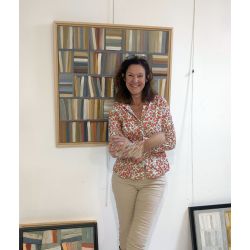
Sublimate, appropriate the subject, keep only the essential.
Born in Paris in 1964, Sophie Dumont lives and works in Langrune-sur-Mer, Normandy.
After several years spent in the Caribbean, Spain, and Morocco, she returned to France in 1991, carrying with her a reservoir of visual impressions, atmospheres, and memories that would later nourish her artistic journey. From an early age, she was drawn to painting, influenced by her grandmother Henriette Dumont, who sketched her family with the instinctive fluidity of a line reminiscent of Matisse.
Self-taught, Sophie Dumont developed her practice through continuous exploration, research, and experimentation. Around 2007, her work reached a defining stage: her oil technique became more layered and textured, her visual language more structured and contemplative. Built in successive strata, her paintings evoke mental landscapes, stylized libraries, or poetic interiors — always suffused with nuance, silence, and light.
Materials such as gauze or kraft paper occasionally enrich the surface, adding tension and transparency. Her palette often features earthy tones, subtle greys, and soft whites, creating a visual rhythm that invites reflection and immersion. While rooted in the Normandy landscape, her paintings move beyond representation to offer a suspended, abstract sense of place — between memory and presence.
Sophie Dumont has exhibited extensively in France and internationally, including in museums and galleries in Germany, Canada, Belgium, and Italy. Her works are included in numerous private and institutional collections across Europe and North America.
CRITICAL
Sophie DUMONT's abstract is not a concept, it is an approach where each canvas is built
around graphics put into perspective by color.
The drawing can recall the shape of a body or the meanders of a landscape. It is only the unpremeditated interpretation of a figurative idea, which takes other forms in space.
The canvas is structured around a play of curves and lines filtering the lights.
It is in this refined construction that the palette of often contrasting tones enters the scene.
But the substance is never raw, drawing from its maturation lyrical effects which are the result of a fruitful work of the material. The knife shapes the material in successive layers that merge into a combination of shimmering colors.
The underlying presence of the different substrates creates this vibration born from the contrast between matter and color, to give the representation a life of its own, independent of any reference. The spectator's gaze, far from being guided, is invited to travel freely in the canvas.
His perception is only the expression of his own emotions, submitted simply to the effect of modulations transcribed by the artist. Hence this permanent relationship between works with sometimes changing appearances and spirit, but which symbolize a coherent and sincere approach.
Francois Laune
Art critic